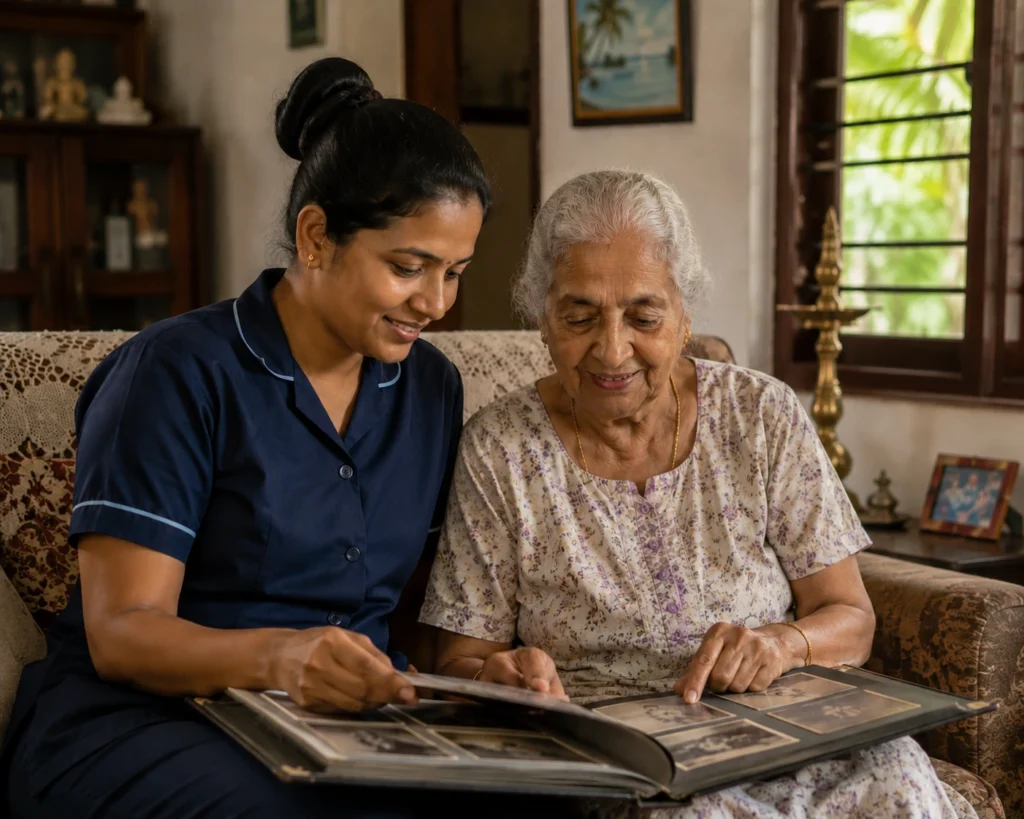
Alzheimer’s and dementia home care in Mangalore and Udupi involves trained caregivers and nurses who provide 24-hour supervision, medication management, cognitive stimulation, and safe daily routines for patients with memory conditions. Home-based dementia care is preferred over nursing homes for most Karnataka families due to the patient’s familiarity with the home environment. Shri Manjunatha Home Nursing Services provides trained dementia caretakers across Mangalore, Udupi, and coastal Karnataka.
Introduction
Caring for a parent or family member with Alzheimer’s or dementia is one of the most emotionally demanding responsibilities a family can take on. The condition is progressive — each month the needs change — and for families in Mangalore and Udupi, managing this while maintaining work and family life is genuinely difficult.
The good news is that home-based dementia care, when set up properly, is often better for the patient than a nursing home. Familiar surroundings, family presence, and consistent caregivers significantly slow the deterioration of orientation and comfort. This guide explains what that care looks like practically and how to arrange it in coastal Karnataka.
Signs It Is Time to Arrange Dedicated Home Care
Many families wait too long. If your family member in Mangalore or Udupi is showing any of these signs, professional home care support is needed now:
Wandering or getting lost in familiar areas of the home or neighbourhood
Forgetting to take medications or taking incorrect doses
Unable to manage cooking, bathing, or dressing independently and safely
Showing aggression, paranoia, or significant personality changes
Falls or near-falls due to spatial disorientation
Family caregiver showing signs of burnout — exhaustion, resentment, or depression
Gulf NRI family members unable to provide oversight from abroad
What Dementia Home Care in Mangalore and Udupi Actually Involves
Care Area
What the Caretaker Does
Why It Matters for Dementia Patients
Daily routine management
Consistent wake, meal, activity, and sleep schedule
Routine reduces confusion and anxiety in dementia patients
Medication supervision
Ensuring correct medicines at correct times
Missed or doubled doses can cause dangerous complications
Soft, familiar meals; assistance with eating if needed
Swallowing difficulty and appetite loss are common in later stages
Family communication
Daily updates, flagging behavioural changes
Critical for Gulf NRI families managing care remotely
Choosing Between a Caretaker and a Nurse for Dementia Patients
For most dementia patients who are otherwise physically stable, a trained caretaker is the primary care provider. A nurse is additionally required when:
The patient has co-existing medical conditions — diabetes, cardiac disease, hypertension — requiring clinical management
There are swallowing difficulties requiring assessment or NG tube feeding
The patient is in a late stage of dementia with significant physical deterioration
Medications include injections or IV-administered drugs
A practical arrangement for many Mangalore and Udupi families: a trained live-in dementia caretaker as the primary carer, with a nurse visiting once daily or every two days for vitals, medication review, and clinical assessment.
The Mangalore and Udupi Context — What Makes Local Care Different
Dementia care in coastal Karnataka has unique cultural dimensions that affect how care should be arranged:
Language matters deeply — an elderly Tulu or Konkani-speaking patient with dementia will respond far better to a Tulu or Konkani-speaking caretaker. As dementia progresses, patients often lose proficiency in secondary languages and revert to their mother tongue
Religious and daily routines — prayers, specific meal timings, particular foods — should be preserved as long as possible; they provide orientation anchors for the patient
Family involvement is expected and beneficial — caretakers should be briefed to work with the family, not replace them
Gulf NRI families managing from abroad should request weekly video updates and have a named local contact alongside the caretaker — usually a neighbour or nearby relative — as a secondary check
Dementia Caretaker Costs in Mangalore and Udupi — 2026
Service
Duration
Cost (₹)
Trained dementia caretaker — day shift
8–10 hours
₹900 – ₹1,400/day
Live-in dementia caretaker
Monthly
₹15,000 – ₹25,000/month
Live-in caretaker + daily nurse visit
Monthly
₹25,000 – ₹38,000/month
24-hour nursing for advanced dementia
Monthly
₹40,000 – ₹60,000/month
Conclusion
Alzheimer’s and dementia care is not a single decision — it is a series of adjustments as the condition progresses. Starting early with the right caretaker in a familiar home environment gives your family member the best possible quality of life for the longest possible time.
For Mangalore and Udupi families — including those managing care from the Gulf — Shri Manjunatha Home Nursing Services provides trained, Tulu and Kannada-speaking dementia caretakers with daily family communication built in. Call us for a free home assessment.
Frequently Asked Questions
Is home care or a nursing home better for dementia patients in Mangalore?
For most patients in the early and middle stages of dementia, home care is significantly better. Familiar surroundings, consistent routines, and family presence reduce confusion and agitation. Nursing homes are typically considered only when the patient requires 24-hour clinical nursing beyond what home care can provide.
Can I find a Tulu-speaking dementia caretaker in Mangalore?
Yes. Shri Manjunatha Home Nursing Services specifically matches caretakers to patient language — Tulu, Kannada, Konkani, and Beary speakers are available. For dementia patients, language match is not optional — it is essential. Please mention this when calling.
How do I manage my parent's dementia care from the Gulf?
We provide daily photo and video updates via WhatsApp, weekly supervisor briefings by call, and immediate alerts for any behavioural or health changes. We also coordinate with local doctors for medication reviews. Many of our Gulf NRI client families have managed Mangalore and Udupi dementia care through us for 2–4 years.
At what stage of dementia should I arrange professional home care?
: As soon as the patient can no longer safely manage daily tasks independently — which is typically the mild-to-moderate stage. Earlier intervention means a smoother transition, a better patient-caretaker relationship, and less crisis-driven decision-making. Do not wait until there is a safety incident.
Does a dementia caretaker need any specific training?
Yes. A good dementia caretaker should have specific training in managing behavioural changes, de-escalating agitation, preventing wandering, and maintaining cognitive stimulation routines. General caretakers without dementia-specific training often struggle and burn out quickly. Always ask about dementia-specific experience when hiring.