Diabetic Wound Care at Home in Karnataka | Nurse Guide 2026

Home Nursing Cost in Bangalore 2026 – Nurse, Caretaker & ICU Pricing
August 23, 2026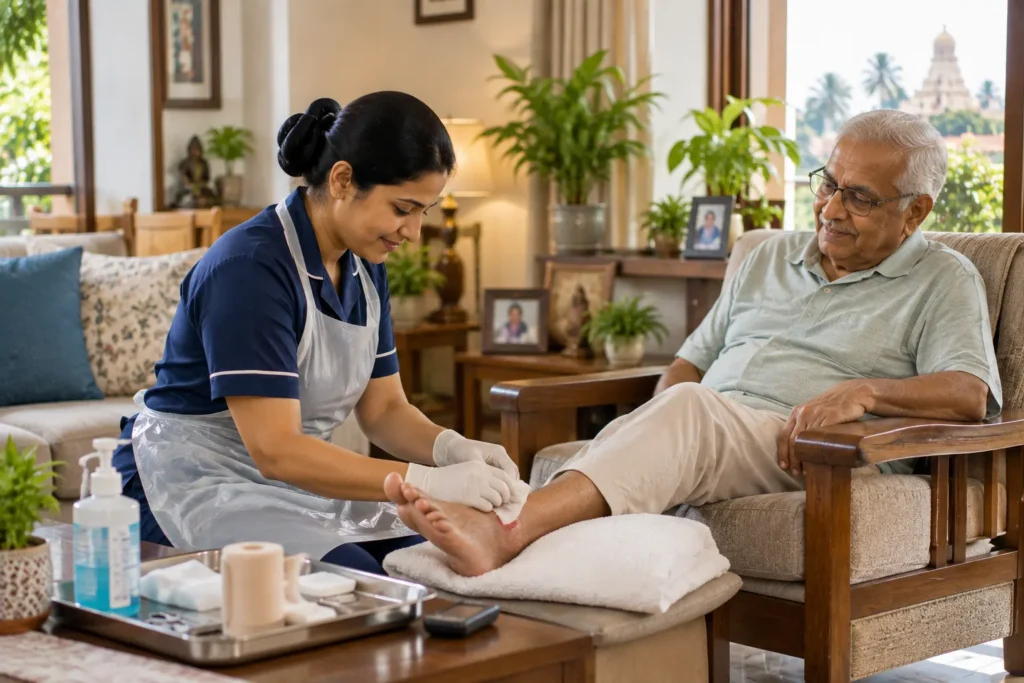
Diabetic wound care at home in Karnataka requires a qualified home nurse for daily wound dressing, infection monitoring, and blood sugar management. Diabetic foot ulcers and post-surgical wounds in diabetic patients heal significantly more slowly than in non-diabetic patients and carry a high risk of infection and amputation if improperly managed. Professional home nursing for diabetic wound care is available across Mangalore, Bangalore, Mysore, Udupi, Shimoga, Hassan, and Chikmagalur. Daily nurse visits for wound dressing in Karnataka cost approximately ₹350–₹800 per visit depending on the city.
Introduction
Diabetes is one of the most prevalent conditions in Karnataka — and diabetic wound complications are among the most serious, most preventable, and most under-managed health problems families face at home. A wound that would heal in two weeks for a non-diabetic person can take months for a diabetic patient, and can progress to deep infection, bone involvement, or amputation if not properly managed.
In coastal Karnataka especially — where dietary habits include high-carbohydrate staple foods and diabetes prevalence is high — families frequently encounter this problem after surgery, injury, or the development of a diabetic foot ulcer. This guide provides a clear, nurse-guided protocol for managing diabetic wounds at home, covering what to do daily, what warning signs require immediate attention, and when a home nurse is essential.
Key Takeaways
- Diabetic wounds require a qualified nurse for dressing — never attempt to manage an open diabetic wound without nursing training
- Blood sugar control is as important as the wound dressing itself — a wound cannot heal in a high-sugar environment
- Signs of infection in a diabetic wound appear differently — redness may be subtle, but smell, warmth, and increased pain are reliable early warning signs
- Daily wound dressing by a nurse costs ₹350–₹800 per visit in Karnataka — far less than the cost of treating a deep infection or amputation
- Diabetic foot ulcers that are not healing after 4 weeks of proper care need specialist vascular or podiatric assessment
- Footwear matters as much as wound care — any pressure on an active ulcer prevents healing, even with perfect dressing technique
- Blood sugar above 180 mg/dL consistently will prevent wound healing — the nurse and family must track and escalate HbA1c concerns to the doctor
Why Diabetic Wounds Heal Differently
Understanding why diabetic wounds are different helps families understand why the care protocol must also be different.
Factor | In Non-Diabetic Patients | In Diabetic Patients |
Blood flow to wound | Normal — adequate oxygen delivery | Reduced — peripheral vascular disease reduces healing capacity |
Immune response | Normal — infection fought effectively | Impaired — bacteria multiply faster, infection spreads more rapidly |
Nerve sensation | Normal — pain signals danger | Neuropathy — patient may not feel the wound worsening |
Tissue repair speed | Normal healing timeline | Significantly slowed — collagen formation impaired by high sugar |
Infection risk | Low to moderate | High — bacteria thrive in high-glucose tissue environment |
Complication risk | Low | High — deep infection, osteomyelitis, amputation risk |
The Daily Diabetic Wound Care Protocol — What Your Nurse Does
- Blood sugar check before wound assessment — healing cannot occur above 180 mg/dL; nurse notes and flags to doctor if consistently elevated
- Remove old dressing carefully — dry dressings should be moistened before removal to avoid stripping new tissue; nurse assesses the wound bed
- Irrigation with normal saline — remove debris, slough, and old exudate; never use hydrogen peroxide or Betadine routinely on healing wounds
- Wound bed assessment — nurse documents size, depth, colour (red=healing, yellow=slough, black=necrosis), smell, and exudate amount
- Apply appropriate dressing based on wound stage — see dressing guide below
- Cover and secure dressing — appropriate dressing must stay in place until next change; nurse advises on keeping it dry
- Document and report — nurse notes changes from previous day and alerts family or doctor to any deterioration
Dressing Guide — Type by Wound Stage
Wound Stage | What It Looks Like | Appropriate Dressing | What to Avoid |
Clean healing wound | Pink/red wound bed, minimal exudate | Hydrocolloid or foam dressing | Dry gauze directly on wound bed |
Infected wound | Yellow/green discharge, smell, warmth | Antimicrobial dressing (silver or iodine-based) — nurse selects | Self-medicating with antibiotics without doctor prescription |
Sloughy wound | Yellow or grey soft tissue covering wound | Hydrogel or enzymatic debridement dressing | Leaving slough in place — it prevents healing |
Necrotic wound | Black/dark brown dry or hard tissue | Medical debridement — nurse cannot manage this alone; doctor required | Any attempt at home debridement |
Deep or cavity wound | Wound extends below skin surface | Alginate or cavity filler — nurse packs the cavity | Leaving cavity empty or covered only at surface |
Warning Signs — When to Call the Nurse or Doctor Immediately
Diabetic wound infections can escalate from manageable to limb-threatening within 48–72 hours. Do not wait for the next scheduled nurse visit if any of these signs appear:
- Increasing pain — especially in patients with neuropathy who previously felt little — increasing pain signals serious infection
- Warmth spreading beyond the wound edge into surrounding skin
- Red streaks extending away from the wound — sign of spreading infection (cellulitis or lymphangitis)
- Foul or unusual smell from the wound — even if the wound looks clean on the surface
- Fever above 38°C in a diabetic patient with an open wound — hospital emergency
- Black or dark discolouration appearing rapidly — may indicate tissue death (gangrene)
- Wound that is not reducing in size after 4 weeks of proper nursing care — needs specialist review
Any of these signs = call your nurse same day. If fever is present with wound signs = go to hospital immediately.
Blood Sugar Management — Why It Matters as Much as the Dressing
No dressing, however sophisticated, can heal a diabetic wound if blood sugar remains consistently high. Glucose above 180 mg/dL impairs every stage of the wound healing process.
- The home nurse checks blood sugar at every visit and records the reading with the wound notes
- If blood sugar is consistently above 180 mg/dL, the nurse should alert the family and treating doctor immediately — not just at the weekly review
- HbA1c above 8% is associated with very poor wound healing — the family should know the patient’s last HbA1c reading
- Diet during wound recovery matters — the nurse and family should ensure carbohydrate intake is managed and the patient is not skipping medications or insulin
Home Nursing for Diabetic Wound Care in Karnataka — Costs
Service | Frequency | Cost in Karnataka (₹) |
Daily wound dressing visit | Once daily | ₹350–₹800 per visit (city-dependent) |
Twice-daily dressing (infected wounds) | Twice daily | ₹600–₹1,400 per day |
Weekly wound assessment report | Weekly | Included in daily visit package |
Monthly wound care package | 30 days (once daily) | ₹8,000–₹18,000 depending on city and complexity |
Mangalore and Mysore rates are at the lower end; Bangalore rates are 20–35% higher. The investment in daily professional wound care is significantly less than the cost of treating a deep infection, hospital admission for sepsis, or the economic and quality-of-life cost of amputation.
Conclusion
Diabetic wound care at home in Karnataka is entirely manageable with the right professional nursing and consistent blood sugar management. The key is starting properly from the first day — with a qualified nurse who knows diabetic wound protocols, not a general caretaker or family member learning as they go.
Shri Manjunatha Home Nursing Services provides experienced wound care nurses across Mangalore, Bangalore, Mysore, Udupi, Shimoga, Hassan, and Chikmagalur. Call us today for a same-day wound care nurse.
Frequently Asked Questions
How often does a diabetic wound need to be dressed at home?
Most diabetic wounds require daily dressing changes. Infected or heavily exuding wounds may need dressing twice daily. Lightly exuding, clean healing wounds may be manageable with every-other-day dressing once healing is well established. Your home nurse will determine the appropriate frequency based on the wound and adjust as healing progresses — never reduce dressing frequency based on cost alone.
Can a family member learn to dress a diabetic wound at home in Karnataka?
With proper training from a qualified nurse, a family member can learn to assist with simple dressing changes for a clean, healing wound. However, the initial assessment, infection detection, dressing selection, and management of any complication must always be done by a qualified nurse. Families should never attempt diabetic wound care without at least the initial training and ongoing nurse supervision.
My diabetic parent's wound is not healing after 6 weeks of nursing — what should I do?
A diabetic wound not showing measurable improvement after 4 weeks of proper nursing care and blood sugar management needs specialist assessment. Request a referral to a vascular surgeon or podiatrist from the treating diabetologist. In Mangalore, KMC and Father Muller’s have vascular surgery departments. In Bangalore, Manipal and Fortis have dedicated wound care clinics. Do not continue with the same approach if there is no improvement.
Is Betadine (Povidone Iodine) good for diabetic wounds?
Betadine is no longer recommended for routine diabetic wound care. While it kills bacteria, it also damages the new tissue cells that are attempting to heal the wound — a net negative effect on healing. Modern diabetic wound care protocols use normal saline for irrigation and specific antimicrobial dressings when infection is present. Your qualified home nurse will use current evidence-based protocol, not outdated practices.
How much does daily diabetic wound dressing cost in Mangalore per month?
Daily wound dressing visits in Mangalore cost approximately ₹350–₹600 per visit, making a monthly package (30 visits) approximately ₹10,500–₹18,000. Shri Manjunatha Home Nursing Services provides monthly wound care packages with a consistent assigned nurse and daily documentation shared with the family. Call us for a specific quote based on your wound type and location.